Laser Marking Systems for the Aerospace Industry

Laser marking has been experiencing rapid growth in recent years, driven by the advancements in and the accessibility of laser technology, coupled with traceability requirements. In the aerospace industry, critical components must be labeled in compliance with rigorous regulatory standards, ensuring that parts can be identified throughout their lifecycle for safety and quality purposes. Common marking methods such as dot peen marking, screen printing, and electrochemical marking have limitations in speed, permanence, and usability – limitations that laser marking tools eliminate.
Laser marking offers a highly efficient way to produce permanent marks that can withstand extreme temperatures, vibration, and chemical exposure. It delivers the speed and reliability essential in aerospace manufacturing and maintenance, where a single illegible serial number or data matrix code could impact safety, compliance, or supply chain tracking. As aerospace companies strive for greater efficiency, accuracy, and accountability, laser marking has become an indispensable tool in their production and quality assurance processes.

What Is Laser Marking?
Laser marking uses a laser beam to create a permanent pattern on a surface. This technology is compatible with a wide range of materials, including metals, ceramics, plastics, and silicon. Unlike other methods, laser marking changes the microstructure of the material – through processes called annealing or ablation – resulting in marks that will not fade, peel, or rub off over time.
This technology is widely used in the aerospace industry and works on such differing materials as: titanium, aluminum, stainless steel, ceramics, thermoplastics, and silicon. Across various industries, laser marking is used to apply serial numbers, part numbers, barcodes, QR codes, logos, and other identifiers directly onto components. This is a high-speed process done by a variety of machines, from compact and portable tools to automated, enclosed workcells. The markings ensure complete part traceability from manufacturing through the entire service life and facilitate compliance with legal requirements.
How It Works
- Infrared light is generated in an optical fiber and a beam travels to the scanhead
- Inside the scanhead, the laser beam gets shaped and focused by the optical components
- The laser beam exits and scans the targeted surface in the programmed pattern
- An engraving (ablation) or discoloration (annealing) in the desired pattern appears on the workpiece
Benefits of Laser Marking in the Aerospace Industry
Superior Precision
Aerospace components often have extremely tight tolerances and complex geometries. Laser marking delivers micro-level accuracy, ensuring that even the smallest data matrix codes, serial numbers, or technical symbols are crisp, legible, and machine-readable.
Durability
When components are exposed to extreme conditions, such as high heat, below-zero temperatures, pressure changes, vibration, and chemicals, labels must be durable. Laser markings are applied into the material itself via change in its microstructure, which makes them resistant to fading or abrasion.
Speed
For aerospace manufacturers and maintenance personnel processing thousands of parts per production cycle, traceability can be a challenge. The speed of laser marking helps reduce lead times, support just-in-time manufacturing, and improve overall productivity.
No Damage
Unlike dot peening or CNC engraving, laser marking is contactless, applying no mechanical impact. This reduces the risk of introducing micro cracks, deformation, or other damage that could compromise the performance or safety of critical aerospace components.
Reduced Footprint
Laser marking eliminates the need for inks, chemicals, drilling bits, or other consumables, reducing hazardous waste and operational costs. This aligns with the industry’s push toward sustainable, eco-friendly manufacturing processes.
Key Considerations for Selecting a Laser Marking Machine
Selecting the right laser marking system is critical for meeting aerospace industry standards while ensuring efficiency, safety, and long-term reliability. Your best choice will depend on several factors:
Understand the Laser Types
Your laser type will depend on the material and level of precision needed. What are the materials you are looking to label, and how small are the required markings? What is the speed of your manufacturing operations at which a marked component is to be rolled out?
Machine Setup
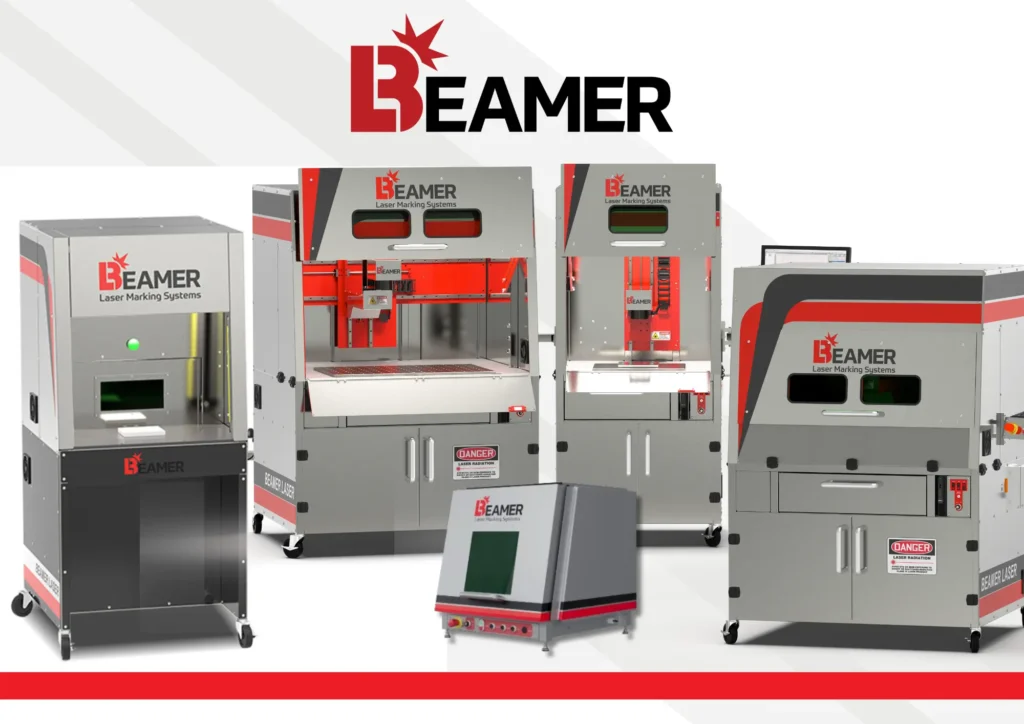
In addition to the type of laser needed for your material, consider a laser machine’s output power, enclosed workcell or open setup, and ease of graphics input and processing. Today, laser systems are available in a wide variety of configurations, from safe CDRH Class I systems to handheld Class IV tools for fieldwork.
Access to Maintenance & Training
Partner with a trusted supplier with proven expertise in laser systems engineering. Ensure you get dependable technical support, onsite or virtual training, and quick access to spare parts to minimize downtime.
Workplace Safety
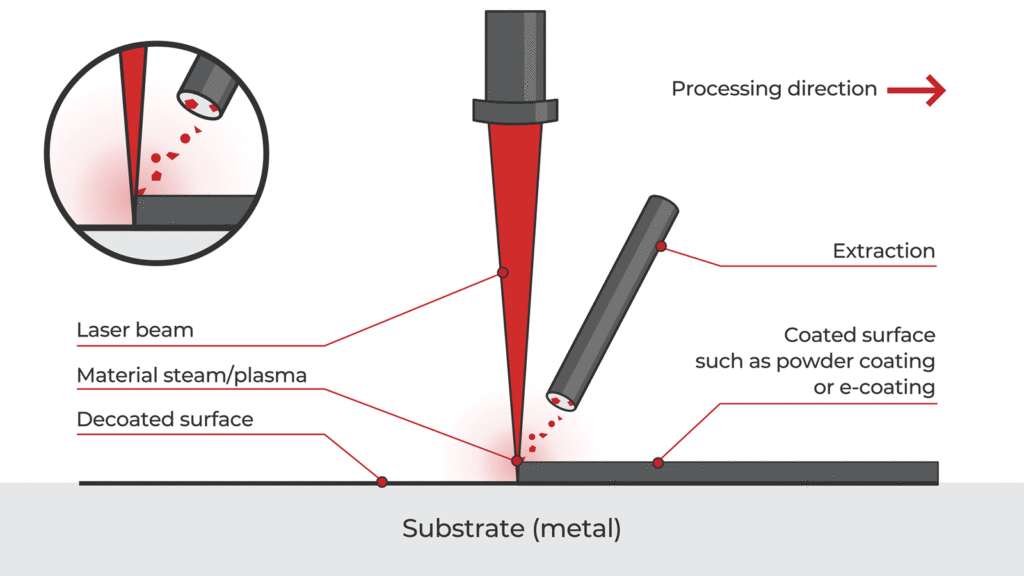
If marking materials that release hazardous fumes or particulates – such as coated metals or composites – make sure the machine supports fume extraction to protect operators and maintain a clean work environment.
Automation
For high-volume production lines, automated laser marking systems can dramatically increase throughput while maintaining consistent quality. Beamer offers automated options for seamless integration with existing manufacturing workflows.
Common Mistakes to Avoid When Selecting a Laser Marking Machine
- Settling for Substandard Devices: They may offer short-term benefits but fail long-term durability.
- Underestimating Safety Risks: Operating lasers requires proper training and observance of safety measures.
- Choosing Incorrect Parameters: Ensure the laser type and its capabilities match your material and application needs.
- Neglecting Maintenance: Proper care extends machine life and ensures optimal performance.
Laser specialists at Beamer can help you choose the laser marking solution that best suits your operations. In our portfolio of laser processing systems, you will find marking solutions in a variety of configurations. And if you’ve got something in mind that you don’t immediately see among our products, contact us – our engineers are on standby to offer custom-tailored options.
