

“L” for Large Field Laser Marking
September 17, 2026
The laser marking machine for large workpieces – for manufacturers who need more. Large and…
Read More →Published October 6, 2026
A Practical Operational Framework for Matching Part Geometry, Cycle Times, and Facility Constraints to the Optimal Laser Platform
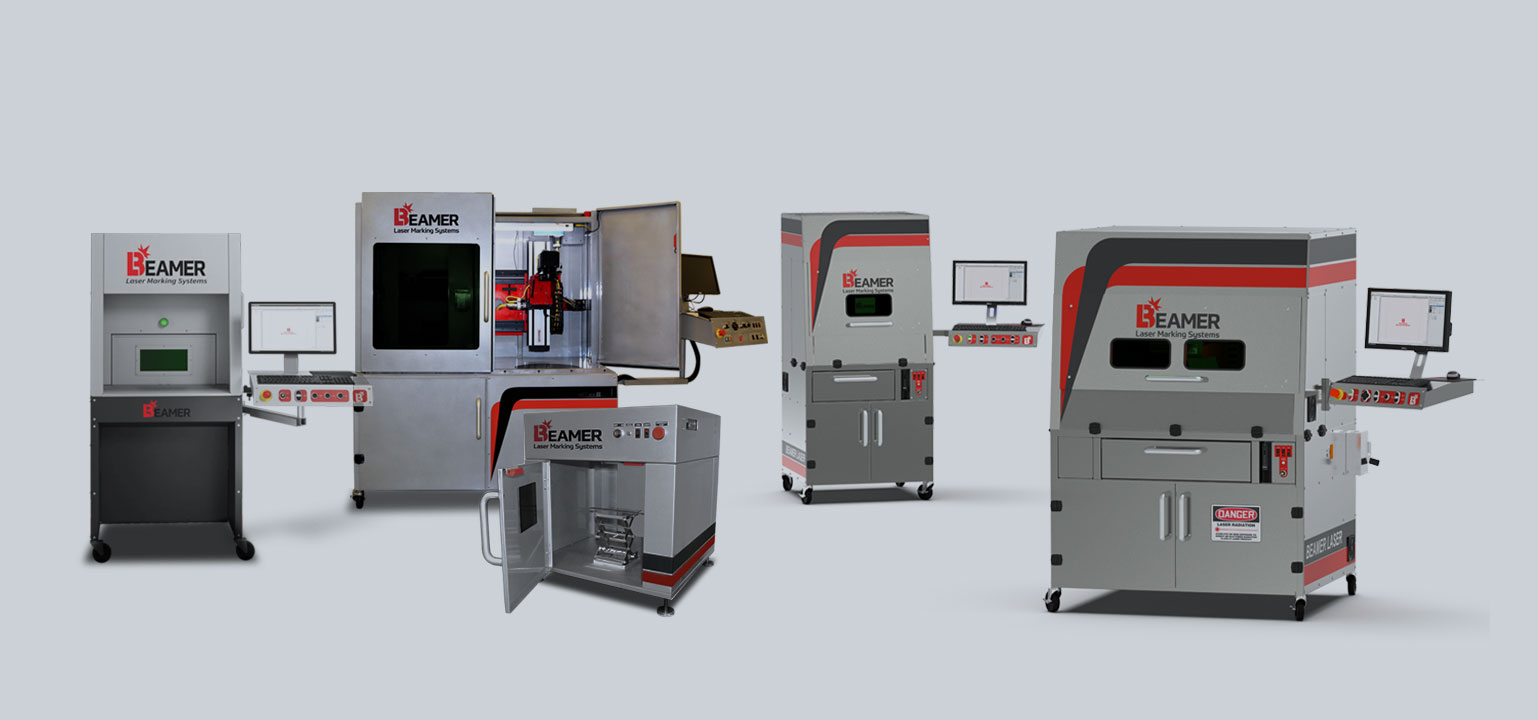
Selecting an industrial laser marking system is a critical capital investment that hinges on a straightforward operational equation: aligning workpiece geometry, target cycle times, and shop-floor constraints with the right equipment architecture.
Before evaluating hardware options, engineering and production teams must define their core operational variables:
To streamline your capital equipment evaluation, this guide outlines how each Beamer system addresses specific production challenges on the manufacturing floor.
The table below compares the core mechanical and operational specifications across the Beamer Laser Marking lineup:
| Series | Primary Architecture | Footprint / Envelope | Max Part / Travel | Best Suited For |
|---|---|---|---|---|
| S-Series | Heavy-Duty Benchtop | 28″ × 25″ Footprint | Up to 5.25″ Height | Entry-level, lab/cell benchtop use, rigid shop-floor stability on a budget |
| B-Series | Scalable Floor Station | 32″ × 28″ Footprint | Up to 13.5″ Height | Manual floor operations with clear scalability to automated workflows |
| M-Series | Mobile Multi-Axis Station | Mobile on Casters (110VAC) | 28″ X / 18.5″ Z Travel | Heavy, oversized, cylindrical parts; multi-axis marking without crane staging |
| L-Series | High-Capacity Gantry | Full Industrial Enclosure | Up to 3.5 ft Length (3-Axis) | Large components, multi-part batch trays, Class I safety without PPE |
| T-Series | Dual-Station Turntable | 32″ × 30″ Footprint | 3-Axis Gantry + Rotary | High-throughput continuous runs; zero-idle loading/unloading |
| Inline | Modular Cell Integration | IP65 Laser Head + Controller | Custom / Conveyor-fed | Direct integration into automated assembly lines & robotic cells |
The Production Challenge: You need industrial-grade structural rigidity, precision, and safety compliance, but your manufacturing footprint is strictly constrained to a workbench, inspection station, or production cell counter.
The Engineered Solution: Eliminating flimsy desktop alternatives, the S-Series packages a heavy-duty welded steel frame into an ultra-compact 28″ × 25″ footprint. Built with a ¼-inch plated steel enclosure, protective safety viewing window, and an internal scissor-lift table supporting parts up to 5.25″ tall, it delivers true shop-floor durability at an accessible entry price point. All operations are driven via a connected PC running Marking Creator 3.0 software.
The Production Challenge: Your facility requires a standalone, dedicated floor station for manual batch marking today, but your growth roadmap requires an easy path to scale automation tomorrow.
The Engineered Solution: Operating as Beamer’s most space-efficient standalone floor model with a compact 32″ × 28″ footprint, the B-Series accommodates workpieces up to 13.5″ high. Available with 20W, 50W, or 100W fiber laser sources, it accelerates production runs with an automated pneumatic door and easily accepts oversized or non-standard components via modular pass-through side panels.
The Production Challenge: Your plant processes heavy, unwieldy, or cylindrical workpieces that require time-consuming manual repositioning, overhead crane rigging, or multi-operator staging.
The Engineered Solution: Engineered for total spatial agility, the M-Series incorporates a programmable 28″ X-axis, 18.5″ Z-axis, a 180° articulating/rotating head, and an integrated 360° rotary turntable. Mounted on heavy-duty lockable casters and powered by standard 110VAC utility power, this open-architecture station brings the marking head directly to massive workpieces—complete with automated focus sensors and safety door interlocks.
The Production Challenge:Production schedules demand marking large-scale components, extended shafts, or dense multi-part nested trays that standard enclosure cabinets cannot accommodate.
The Engineered Solution: Constructed around a robust three-axis (X, Y, Z) gantry system, the L-Series handles massive workpieces up to 3.5 feet in length. Certified as a CDRH Class I laser safety enclosure, it integrates fast-gliding pneumatic doors and fold-down side panels to streamline mechanized loading, crane placement, or heavy custom fixturing without requiring operator personal protective equipment (PPE).
The Production Challenge:Operator load/unload idle time creates a severe bottleneck, throttling total machine throughput on high-volume production lines.
The Engineered Solution:The T-Series utilizes a high-speed dual-station rotary indexing turntable to achieve near 100% laser uptime. The operator loads and unloads parts safely in the open-air external station while the laser marks the enclosed internal batch. Upon cycle completion, the table indexes instantaneously. Housed in an ultra-efficient 32″ × 30″ footprint, it pairs a 3-axis programmable gantry with continuous high-speed workflow optimization.
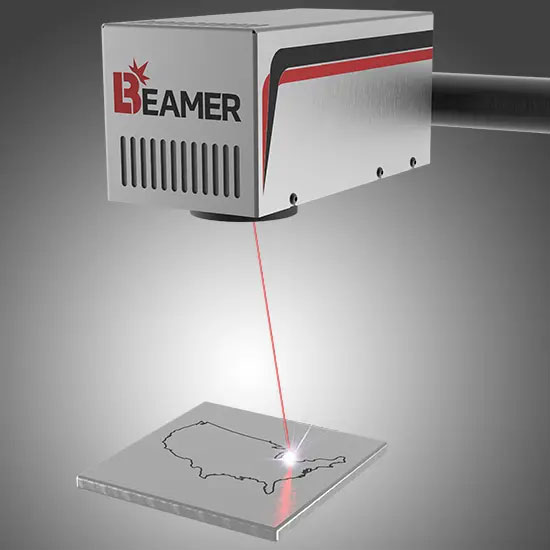
The Production Challenge: You need to embed direct part marking (DPM) and traceability into an existing high-speed automated assembly or packaging line without re-engineering facility infrastructure.
The Engineered Solution: Engineered specifically for turnkey industrial integration, the Inline Series features a rugged IP65-rated marking head built to withstand dust, moisture, and vibration, connected to a sealed, powder-coated steel controller. Powered by standard 110V air-cooled architecture, it interfaces natively with master PLCs and robotics via TCP/IP, EtherNet/IP, and Digital I/O, featuring integrated pilot lasers and focal distance pointers for rapid installation and optical alignment.
Beamer laser systems are engineered to process a comprehensive range of industrial substrates, executing permanent marks with micron-level precision across demanding manufacturing environments:
Selecting the ideal configuration requires empirical validation. Beamer’s application engineering team provides comprehensive feasibility and testing services prior to procurement:
Ready to optimize your marking workflow? Contact the Beamer Laser Engineering Team today to map out the exact platform, optics, and power configuration for your facility.